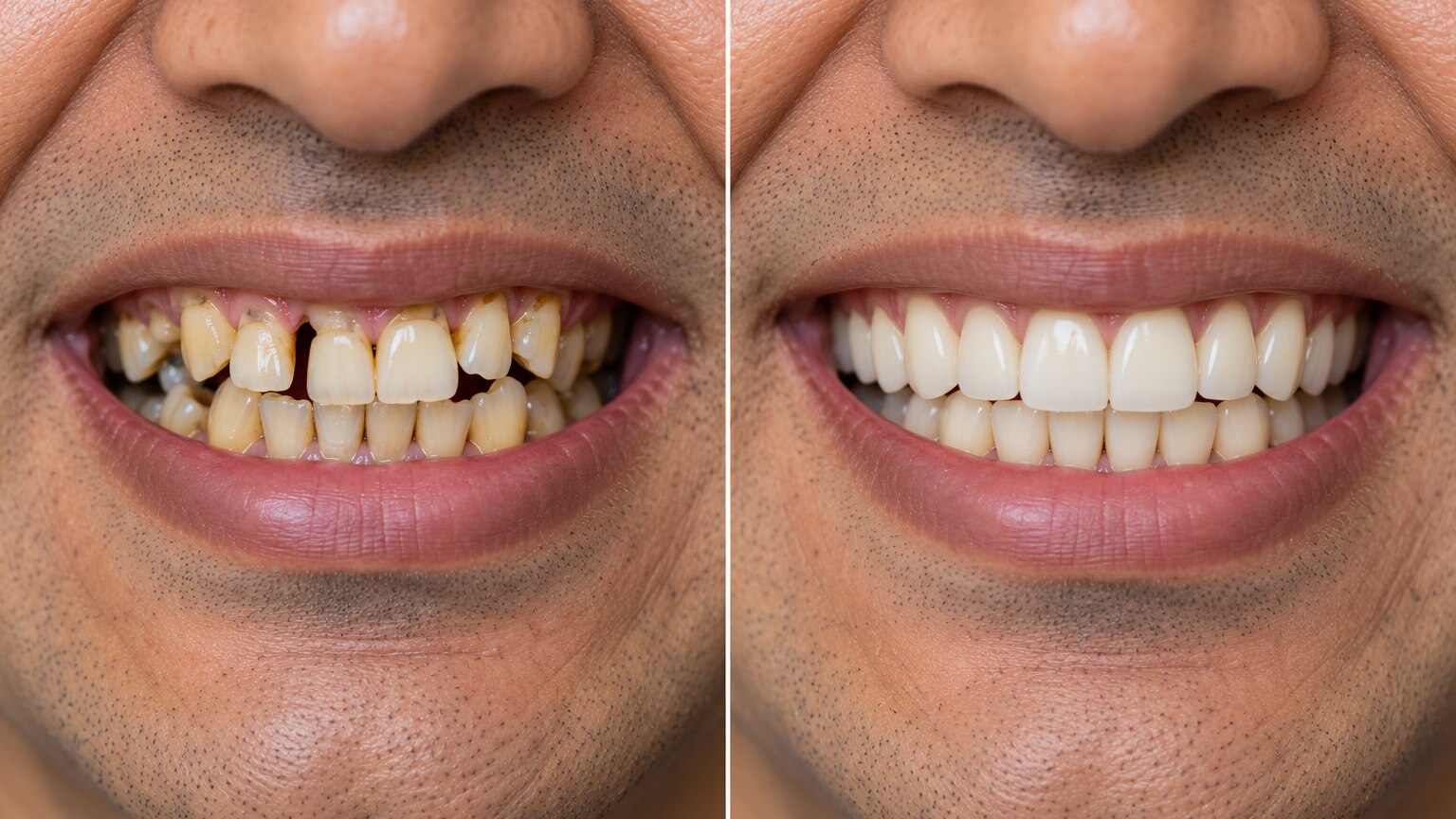
Missing back teeth, painful chewing, and worn or broken teeth can force you to avoid foods while concentrating bite pressure on the teeth that remain. A useful treatment plan starts by measuring how you chew, then matches tooth preservation, disease control, and tooth replacement to your bone, gums, bite, health, budget, and ability to maintain the result.
Key takeaways
- Replace missing back teeth to restore stable chewing contacts.
- Save a damaged tooth when its root and supporting bone remain treatable.
- Treat gum disease and bone loss before relying on restorations.
- Stage rehabilitation so healing, bite changes, and maintenance stay manageable.
Why several damaged or missing teeth change the way you chew
Several damaged or missing teeth reduce chewing efficiency by removing stable contact points, especially when you have missing back teeth. Food is then crushed on fewer surfaces, while tilted or worn teeth receive uneven bite force and may become overloaded.
Painful chewing changes behaviour as well as mechanics. You may avoid meat, raw vegetables, nuts, or other firm foods, chew on one side, swallow larger pieces, or stop using a painful tooth. Those adaptations strain the jaw muscles and may worsen wear, cracks, mobility, or sensitivity in the remaining teeth.
Before treatment, a clinician needs a functional baseline rather than a count of missing teeth:
- Review your medical history, medicines, previous dental work, jaw symptoms, diet, grinding, dry mouth, and the foods you avoid.
- Examine every tooth for decay, cracks, wear, looseness, infection, restorability, and contact with neighbouring teeth.
- Measure gum-pocket depths, bleeding, recession, tooth mobility, and the supporting bone.
- Assess jaw joints and chewing muscles for tenderness, clicking, restricted movement, or fatigue.
- Record how the upper and lower teeth meet, including premature contacts, sliding, bite force distribution, available restorative space, speech, and facial proportions.
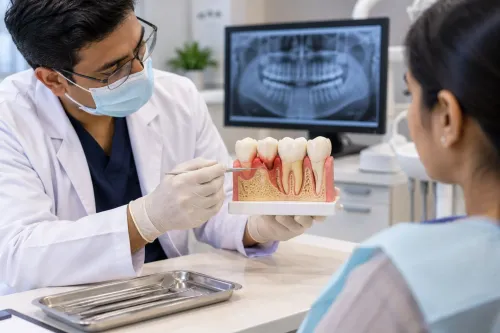
- Use photographs, intraoral scans or impressions, and dental X-rays. Request 3D cone-beam imaging when implants, impacted roots, or remaining bone require three-dimensional assessment.
These findings show whether pain comes from one tooth or an unstable chewing system, and identify which teeth can safely carry future loads.
What a coordinated rehabilitation plan changes compared with one-tooth treatment
A full mouth rehabilitation plan coordinates the teeth, gums, bite, jaw joints, and replacement timing instead of treating each gap or symptom in isolation. It determines which teeth can be saved, which can carry chewing forces, and how tooth replacement options will work together.
| Option | What changes | Main limitation |
|---|---|---|
| One-tooth replacement | Restores one gap with an implant, crown, or other restoration | It does not correct worn teeth, a shifted bite, gum disease, or overloaded neighbours |
| Fixed bridge | Replaces a missing tooth using adjacent teeth as supports | Suitable abutment teeth must withstand extra force and may require preparation |
| Removable partial denture | Replaces several teeth without extensive surgery | A removable partial denture can move, collect plaque, and transfer load to supporting teeth |
| Treating painful teeth only | Relieves urgent symptoms such as decay or infection | Pain relief does not correct missing back-tooth support or uneven force distribution |
| Extraction with complete dentures | Removes failing teeth and replaces an entire arch | Complete dentures restore basic function but move more easily, especially in the lower jaw, and chew hard foods less effectively |
The coordinated approach sequences disease control, tooth preservation or extraction, gum treatment, temporary restorations, bite adjustment, and definitive crowns, bridges, dentures, or implants. It does not automatically mean removing every questionable tooth; strategic value, bone support, restorability, and your ability to maintain each tooth matter.
The result also requires maintenance. Recall visits check gum health, implant bone levels, bite changes, fractured ceramics, worn denture teeth, and removable attachments before small problems disrupt chewing.
When saving a damaged tooth is better than extracting it
Extraction is not the default for a damaged tooth. Clinicians assess tooth restorability by checking remaining tooth structure, cracks, root and canal anatomy, gum attachment, bone support, strategic value, and whether you can keep the tooth clean. A small cavity may need a filling; greater structural loss may call for an onlay or crown.
If decay or trauma has infected the pulp, root canal treatment followed by a restoration can save a damaged tooth. Removal becomes more sensible when a crack extends below the gum, support is severely lost, or predictable cleaning and repair are impossible.
| Option | What it requires | Main trade-off |
|---|---|---|
| Bridge | Strong neighbouring abutment teeth | Fixed replacement, but those teeth need preparation and carry extra load |
| Dental implant | Adequate bone, surgery, hygiene, and maintenance | Avoids cutting adjacent teeth, but takes longer and requires surgery |
| Removable partial denture | Suitable supporting teeth and daily removal | Less invasive and easier to repair, but can move and load abutments |
The dental implant versus bridge decision depends on bone, gum health, adjacent teeth, cost, cleaning ability, and surgical tolerance—not simply chewing strength. A removable replacement suits people who need easier inspection, relining, or repair; an implant-supported overdenture can improve stability without making the entire replacement fixed.
A fixed implant bridge may feel more tooth-like, but it still demands meticulous maintenance. Active decay, gum infection, or poor plaque control must be treated before definitive work.
How gum disease, bone loss, and health conditions affect the plan
Active periodontal infection must be controlled before final crowns, bridges, or dental implants. Uncontrolled inflammation and poor plaque control can damage supporting teeth and cause peri-implant mucositis to progress to peri-implantitis, with bone loss around an implant. A history of gum disease and dental implants therefore demands regular supportive care.
Jawbone loss can leave too little width or height to anchor an implant safely, or place the proposed implant near a nerve or sinus. Cone-beam imaging shows whether the clinician can use the existing bone, change the implant position, choose another replacement, or add surgery.
Bone grafting rebuilds deficient bone but adds healing time, cost, and surgical risk. If bone is short beneath the upper back teeth, sinus augmentation can create grafted space below the sinus floor before implant placement. Neither procedure is automatic; the scan and planned restoration determine whether it is justified.
Smoking raises the risk of impaired healing and peri-implantitis. Your medical history also affects medication choices, healing, and surgical safety, especially with poorly controlled diabetes, blood-thinning medication, or treatments that alter bone turnover. The plan must match your ability to brush, clean between teeth, attend maintenance visits, and tolerate surgery.
If complex surgery or daily cleaning is unrealistic, a tooth-supported or removable design may restore chewing more safely. Definitive treatment waits until disease control and hygiene are reliable, then maintenance checks the gums, implant bone, bite, and prosthesis for changes.
How treatment is staged and maintained after chewing improves
Expect temporary restorations to function as a trial, not merely a waiting-room substitute. These provisional restorations let you test comfort, speech, appearance, chewing, cleaning, and tolerance of the proposed bite before crowns, bridges, dentures, or implants become harder to alter.
Treatment is usually advanced in stages:
- Control active gum infection, untreated decay, and plaque before final work; otherwise disease can undermine supporting teeth and prostheses.
- Adjust the bite gradually. A bite adjustment that removes a high contact can prevent soreness, fractured porcelain, and overload on remaining teeth.
- Recheck the trial teeth, then place definitive crowns or bridges when the contacts, shape, and cleansability are stable.
- For dentures, expect adjustments to the base, borders, and denture teeth as sore spots or looseness appear.
- For implants, allow healing and integration before attaching the final crown or denture. Implant-supported dentures improve stability but still require changes in chewing habits and periodic replacement of worn attachments, acrylic, or teeth.
Whether treatment is provided at Dental Junction or elsewhere, ask for the review schedule and which changes require an appointment rather than self-adjustment.
Protect chewing function with ongoing care:
- Attend recalls for gum-pocket measurements, bite changes, fractured ceramics, and worn denture teeth.
- Follow cleaning instructions around crowns, bridges, dentures, and implants.
- Arrange implant maintenance to detect inflammation and bone loss early; untreated peri-implant disease can loosen an implant.
- Report new pain, movement, bleeding, food trapping, or a change in how your teeth meet.
Frequently asked questions
Why do several missing or damaged teeth affect chewing?
They remove stable contact points, shift chewing onto fewer teeth, and increase uneven force on tilted or worn teeth.
How does full mouth rehabilitation differ from treating one tooth?
It coordinates the bite, gums, remaining teeth, and replacements so each restoration works with the rest of your mouth.
When is saving a damaged tooth better than extracting it?
Saving it is preferable when the tooth has a restorable structure, a treatable root, and enough healthy bone and gum support.
How do gum disease, bone loss, and health conditions affect treatment?
They can change the timing, suitability, and support for restorations, so infection, gum stability, bone levels, and relevant health conditions must be assessed first.
How is full mouth rehabilitation staged and maintained?
Treatment is divided into assessment, disease control, tooth repair or replacement, bite adjustment, healing, and regular maintenance.