Replacing a missing tooth with an implant is a staged process involving surgery, healing, and a separate restoration. Before you agree to treatment, you need to understand the components, the time involved, the checks that determine eligibility, and how implants compare with bridges or removable dentures.
Key takeaways
- Implants need healing time before the final crown is fitted.
- Ask how bone volume, gum health, and medical history affect your plan.
- Compare an implant with a bridge and removable partial denture.
- Confirm the full timeline, costs, risks, and maintenance before consenting.
What happens from the first consultation to the final crown?
1. Implant treatment stages usually include assessment, planning, any extraction or grafting, implant placement, healing, abutment placement, and final crown fitting. The visible tooth is not usually fitted immediately because the implant must become stable inside the jawbone first.
2. At the consultation, the dentist reviews your medical and dental history, examines your teeth, gums, bite, and available bone, and takes clinical photographs. Dental X-rays, and sometimes a cone-beam CT scan, show root positions, bone volume, and nearby structures so the implant can be planned safely.
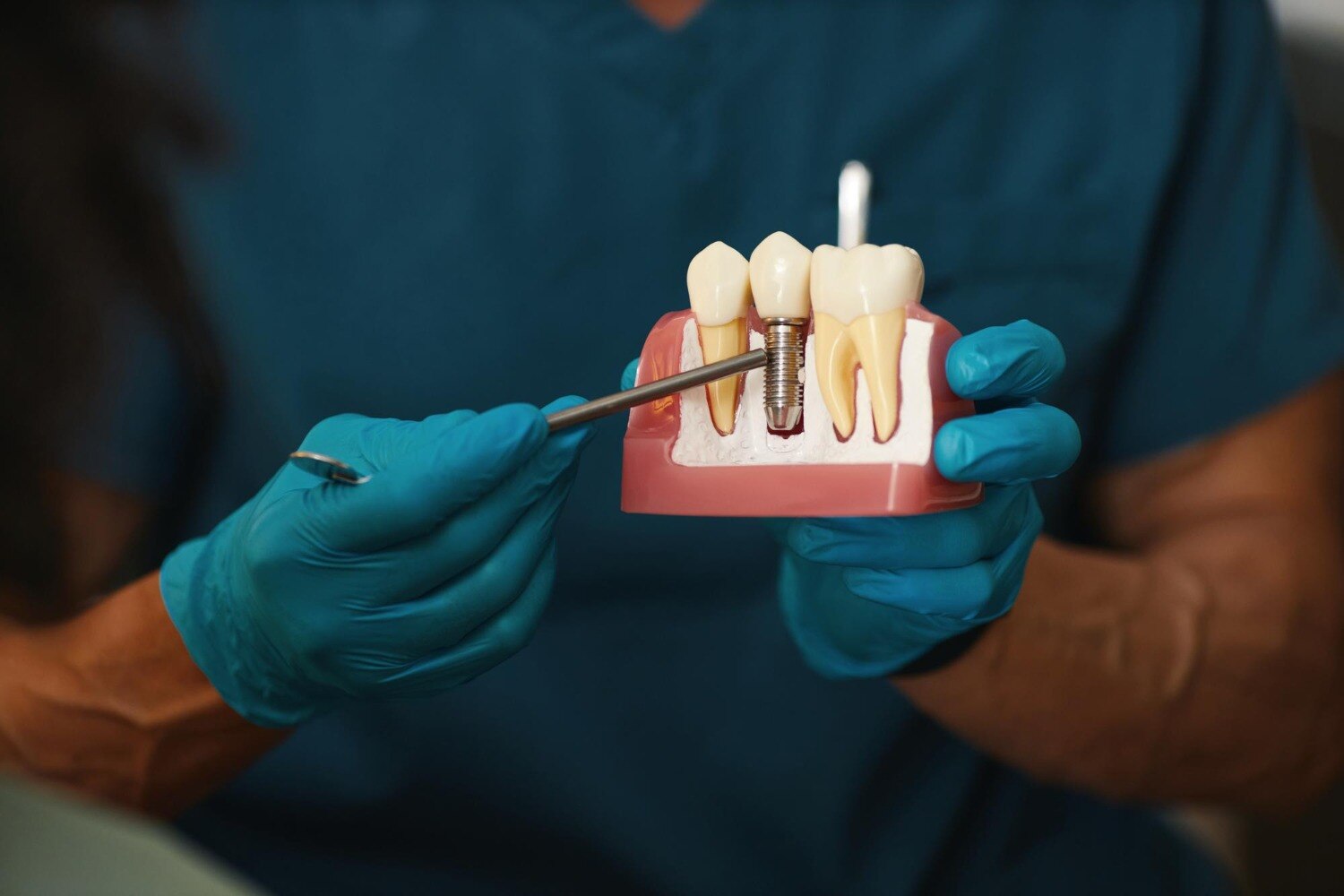
3. If the damaged tooth remains, extraction comes before or during implant placement. An implant fixture is the root-like component placed in the bone. Immediate implant placement means inserting it after extraction, but only when the socket, infection status, remaining bone, and primary stability are suitable.
4. The healing phase allows osseointegration, the direct bonding of bone to the fixture. This usually takes 3 to 6 months. A bone graft adds another healing period when the site lacks sufficient support.
5. Immediate loading means attaching a temporary or final restoration soon after surgery when stability and bite conditions allow it. Delayed loading means waiting through healing before attaching the restoration. These are separate decisions from immediate implant placement, and neither guarantees same-day teeth.
6. After osseointegration, the abutment connects the fixture to the restoration. The crown is the visible part that replaces one tooth. Your dental crown fitting time includes checking the shape, colour, contacts, and bite before the crown is secured.
How do bone, gums, health, and imaging affect eligibility?
Dental implant eligibility depends on whether bone can support the fixture, infection is controlled, and your health allows predictable healing. Assessment should cover:
- Jawbone volume: measure height, width, and density at the proposed site. A narrow, short, or weak ridge may need bone grafting before placement.
- Infection: treat active gum disease and tooth decay first. A history of periodontitis still raises peri-implant disease risk after tooth removal, so periodontal infection must be controlled.
- Daily care: check oral hygiene, because persistent plaque can inflame gums around the implant.
- Healing factors: discuss smoking and implant healing, diabetes and dental implants, medicines that affect bone or healing, and conditions such as immune disorders or uncontrolled medical disease. Poorly controlled diabetes increases complication risk; a diabetes diagnosis alone does not automatically exclude treatment.
Ordinary dental radiographs show teeth, roots, and general bone height. A CBCT scan provides three-dimensional jawbone volume and maps the mandibular nerve or maxillary sinus, but exposes you to more radiation. Use it when that extra detail changes surgical planning, not as an automatic test.
Bone grafting can rebuild a deficient ridge. A sinus lift can add bone beneath the upper-jaw sinus. Either may make placement possible, but each adds healing time and can extend treatment by several months.
Discuss infection, altered sensation from nerve injury, and upper-jaw sinus complications before surgery. Anatomy and implant position determine these risks, not simply the implant brand or material.
Is an implant better than a bridge or removable partial denture?
An implant is not automatically the best replacement for a missing tooth. Compare dental implant alternatives against your tooth position, bite, appearance, bone and gum condition, general health, and willingness to undergo surgery and long-term maintenance.
| Option | Stability | Tooth preparation and treatment time | Maintenance and reversibility |
|---|---|---|---|
| Dental implant | Fixed and supported by bone; does not rely on neighboring teeth | No tooth preparation for adjacent teeth, but requires surgery, healing, and more appointments; implant treatment time is longer | Brush and clean around the implant; surgery makes reversibility more involved |
| Fixed dental bridge | Fixed replacement supported by neighboring teeth | A bridge can be fitted sooner, but supporting teeth require substantial tooth preparation | Clean under the bridge and monitor its supports; removing it can damage prepared teeth |
| Removable partial denture | Removable; stability depends on clasps or other supports | Avoids implant surgery and can replace several teeth, with a faster initial process | Remove it for cleaning; adjustment or replacement is straightforward, making reversibility higher |
The least invasive option is not always the lowest long-term burden. An implant avoids cutting down healthy adjacent teeth, while a bridge places chewing forces and future maintenance on those teeth. A removable partial denture avoids surgery but can move during eating and affect comfort or appearance.
Implant cost drivers include extraction, grafting, CBCT imaging, surgical complexity, the number and type of restorations, laboratory work, and follow-up. The question of when not to replace a missing tooth depends on function, appearance, and risk; monitoring or a non-implant restoration can be reasonable. Assess dental implant alternatives with a clinician before choosing surgery.
What risks and maintenance continue after the crown is fitted?
Long-term dental implant maintenance includes daily cleaning, professional examinations, and scheduled maintenance visits. Implants cannot develop cavities because they contain no enamel or dentin, but plaque can cause peri-implant mucositis, with inflamed soft tissue, or peri-implantitis, which causes inflammation and progressive supporting-bone loss. Untreated peri-implantitis can lead to implant failure and implant loss.
At home, brush twice daily with a soft toothbrush and clean beneath and around the crown with interdental brushes, floss designed for implants, or a water flosser. Do not ignore bleeding, swelling, pus, bad taste, pain, looseness, or a change in how your teeth meet.
- Attend examinations at the interval your dentist sets. Maintenance visits assess inflammation, gum recession, bone levels, loose screws, wear, bite changes, and crown damage.
- Tell your dentist if you have previous periodontitis, smoke, struggle with oral hygiene, or have uncontrolled diabetes. These factors raise concern for peri-implant disease, so periodontitis and implants require ongoing monitoring around the implant and remaining teeth.
- Understand that the integrated implant and its attached restoration have different service lives. The implant can remain stable while a crown, bridge, or denture needs repair or implant crown replacement because of fracture, wear, screw loosening, recession, or changing bite forces.
- Discuss implant surgery risks based on your anatomy and implant position, including infection, nerve-related altered sensation, and upper-jaw sinus problems—not simply the implant brand or material.
What should you confirm before consenting to treatment?
Ask these questions before dental implants, then record the answers in your implant consent documents. Confirm which tooth or teeth will be replaced, whether extraction is needed, and whether the site is suitable for immediate placement. Ask whether bone grafting or a sinus lift is likely.
- Ask to see the proposed X-rays or CBCT scan. Have the clinician explain the planned implant’s relationship to the mandibular nerve or maxillary sinus.
- Confirm immediate, early, or delayed loading, the expected healing interval, and the temporary tooth during healing.
- Ask which fixture, abutment, and crown materials are planned, and why they suit your bite and appearance.
- Request the full sequence of appointments, including surgery, healing checks, restoration, and implant follow-up.
- Ask what happens if osseointegration fails, including removal, replacement, extra healing, and additional fees.
| Item | Confirm | Why it matters |
|---|---|---|
| Surgery | Extraction, grafting, sinus lift, and surgical fee | These alter risk, timing, and cost |
| Restoration | Abutment, crown, temporary teeth, and laboratory charges | The fixture alone is not the finished tooth |
| Maintenance | Examinations, cleaning, repairs, and maintenance fee | The implant and crown need continuing care |
Request a written implant fee breakdown separating surgical fees, imaging, grafting, temporary teeth, abutment, crown, and maintenance. Ask who manages gum disease, restorative work, surgery, and follow-up. Dental Junction may suit plans needing coordinated multi-specialty dental care; judge the proposed plan and maintenance system, not the clinic name alone.
Related service
Implants Dental implants are a permanent and reliable solution for replacing missing teeth. View service → |
Frequently asked questions
What happens from the first consultation to the final crown?
Treatment usually involves assessment, imaging, planning, extraction or grafting when needed, implant placement, healing, abutment placement, and final crown fitting.
How do bone, gums, health, and imaging affect eligibility?
Your dentist assesses jawbone volume, gum health, oral hygiene, medical conditions, medicines, smoking, and scans before recommending treatment.
Is an implant better than a bridge or removable partial denture?
The best choice depends on bone and gum health, adjacent teeth, appearance, budget, treatment time, maintenance, and your preference.
What risks and maintenance continue after the crown is fitted?
Risks include infection, inflammation around the implant, loosening, crown damage, and failure. Brush, clean between teeth, attend reviews, and report bleeding or movement.
What should you confirm before consenting to treatment?
Confirm the treatment stages, alternatives, healing time, grafting needs, total fees, aftercare, expected lifespan, risks, and who will provide follow-up care.