Bleeding gums or a deep periodontal pocket does not automatically make laser treatment the next step. You will be able to match laser use to the gum finding, understand how it fits with scaling and root planing, and ask whether the proposed wavelength, protocol, cost, and follow-up have a sound clinical reason.
Key takeaways
- Bleeding gums alone do not establish a need for laser treatment.
- Ask for pocket-depth measurements and the location of persistent inflammation.
- Compare laser treatment with scaling, root planing, and possible periodontal surgery.
- Clarify expected discomfort, aftercare, follow-up measurements, and total treatment stages.
Which gum-disease findings make a laser worth considering?
A laser is worth considering when examination finds persistent disease at a site that standard mechanical treatment cannot fully address, not simply because you have bleeding gums. The dentist must identify the condition, measure periodontal pocket depth, and locate persistent inflammation below the gumline.
| Finding | What it supports | What it does not prove |
|---|---|---|
| Gingivitis | A laser may assist selected soft-tissue procedures or inflamed areas after plaque control is addressed. | It does not replace daily plaque removal or prove that gingivitis needs laser treatment. |
| Periodontitis with residual pockets | Inflamed tissue or deposits remaining after scaling and root-surface debridement may justify discussing laser as an adjunct. | A laser does not automatically eliminate infection, reverse gum recession, or regenerate lost bone. |
| Peri-implant disease | Persistent inflammation around an implant warrants assessment of peri-implant mucositis or peri-implantitis; laser evidence must be considered separately. | Results from natural-tooth periodontitis studies do not prove predictable implant-surface decontamination or implant salvage. |
| Excess or reshaped gum tissue | Laser surgery may improve access or reshape soft tissue in a planned procedure. | Less bleeding or less discomfort does not show that underlying periodontal disease was comprehensively treated. |
Gum recession alone is not a laser indication. Deep pockets, bleeding on probing, attachment loss, mobility, and bone loss on dental X-rays matter more than the treatment label.
Treat claims of painless treatment, permanent infection removal, or guaranteed bone regeneration cautiously. Persistent bleeding or deep pockets after treatment call for reassessment and periodontal maintenance, not automatic repeat laser therapy.
How does a dentist decide whether laser treatment suits your case?
Suitability starts with diagnosis, not the laser’s brand or wavelength. Periodontal charting records each tooth’s pocket measurements in millimetres, gum bleeding during probing, recession, and attachment loss. A site that bleeds and remains deep after thorough scaling may justify discussing laser use as an adjunct; a shallow, healthy site does not.
Tooth mobility changes the decision because it can indicate advanced support loss, an unfavourable bite, or a cracked root. Dental X-rays show bone loss, defects around individual teeth, furcation involvement, and root shape that probing alone cannot reveal. A laser cannot rebuild lost attachment or bone simply because those findings appear on an image.
Your medical history also affects suitability. Smoking reduces healing potential, and poorly controlled diabetes increases periodontal inflammation and complicates infection control. Tell the dentist about anticoagulants, immune-suppressing medicines, previous radiation to the jaws, pregnancy, and conditions that affect healing before treatment is planned.
The proposed laser procedure must match the diagnosis: pocket decontamination, removal of inflamed tissue, reshaping, or surgical access are different treatments. Ask what measurable problem it will address and how success will be checked. Persistent gum bleeding, deep pockets, or worsening mobility after treatment calls for reassessment, not automatic repeat laser therapy.
Around dental implants, peri-implant disease requires separate evaluation because evidence from natural-tooth periodontitis does not establish predictable implant salvage.
What happens during laser-assisted periodontal treatment?
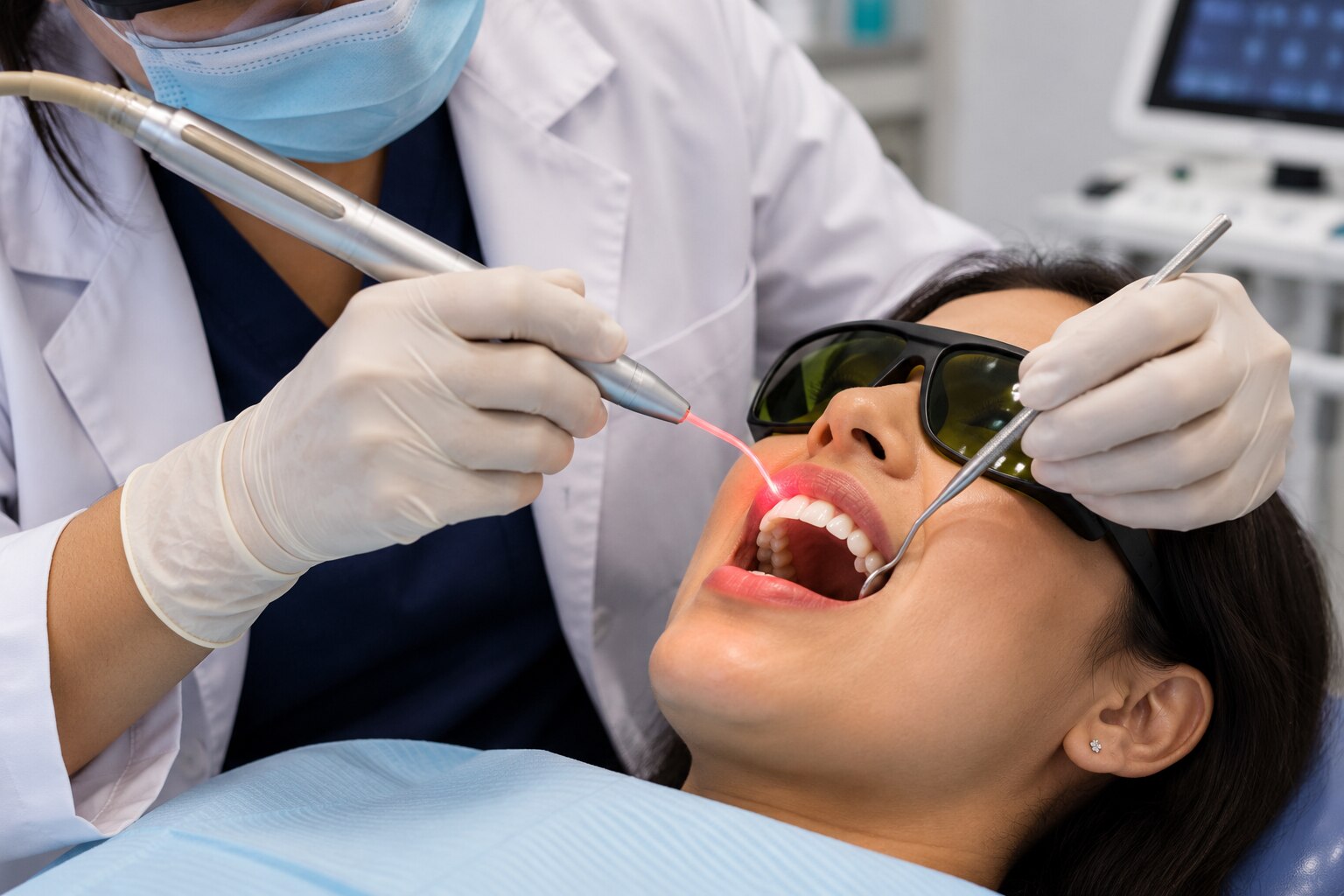
Treatment usually begins with local anaesthetic and access to the gum pocket. The clinician reaches the pocket lining and root surfaces through the gum margin or, for deeper areas, a small surgical opening.
- The clinician removes the inflamed pocket lining and hardened deposits with instruments. This mechanical cleaning includes scaling and root planing, also called root-surface debridement.
- Irrigation flushes loosened debris from the pocket. The clinician may use an antimicrobial solution, depending on the treatment plan.
- The laser may remove selected soft tissue, reduce bleeding, or target deposits and bacteria that remain after instrumentation. Its effect depends on the wavelength, energy settings, cooling, and technique.
- The clinician may reshape excess or irregular gum tissue to improve access, contour, or plaque control. Reshaping does not by itself repair lost attachment or bone.
A laser is an adjunct, not a universal replacement for mechanical treatment. You still need plaque-control instruction and professional cleaning; antibiotics belong in the plan only when their indication is clear. Persistent deep pockets, advanced tissue destruction, or an area that cannot be cleaned adequately may require periodontal surgery instead.
A clean-looking, relatively bloodless site does not prove that periodontitis has been eliminated.
How does laser treatment compare with conventional gum treatment?
Conventional scaling and root-surface debridement remains the benchmark. A laser can support mechanical treatment, but it does not reliably replace deposit removal, periodontal surgery, or maintenance.
| Laser | Main periodontal use | Evidence and practical trade-off |
|---|---|---|
| Diode laser | Soft-tissue removal and coagulation in pockets | Small short-term changes in bleeding or pocket depth are possible; evidence is mixed, and added equipment increases cost. |
| Nd:YAG | Selective soft-tissue treatment and coagulation | Bleeding during treatment may be reduced, but results depend heavily on settings and operator technique; predictable long-term superiority is unproven. |
| Er:YAG | Hard-tissue and soft-tissue ablation, including calculus access in selected cases | It may improve pocket measurements when combined with debridement, but studies vary in protocol and certainty. |
| Er,Cr:YSGG | Water-mediated soft- and hard-tissue treatment | It can support access or tissue reshaping, yet evidence does not establish consistent gains beyond conventional care. |
Do not assume a laser means fewer visits. Most patients still need planned debridement, reassessment, and supportive periodontal care every few months; healing time, discomfort, and post-treatment sensitivity vary, while soft-tissue coagulation can reduce visible bleeding during treatment.
Incorrect energy settings, inadequate cooling, or prolonged exposure can thermally injure gingiva, periodontal ligament, cementum, or bone. Laser treatment also has no reliable proof of improving long-term tooth retention or regenerating lost bone; true regeneration may require flap surgery, a membrane, or grafting.
Ask for the measurable endpoint and total fee before accepting the added cost.
What should you expect after treatment, and what should you ask before agreeing?
Expect post-treatment sensitivity, tender gums, and light bleeding for a short period; ask when these symptoms require review. Your dentist should give written oral-hygiene instructions, including brushing, interdental cleaning, rinsing, and whether to avoid the treated area temporarily.
Follow the stated eating restrictions rather than guessing. Ask whether you must avoid hot, spicy, hard, or crunchy foods, alcohol, or smoking, and for how long. Attend the planned healing check so the clinician can examine tissue response and measure treated pockets again.
Before consenting, ask:
- Which wavelength and device will be used, and what is the exact protocol for your sites?
- Which periodontal findings are being treated, including pocket depths, bleeding, infection, or peri-implant inflammation?
- What scaling and root-surface debridement, plaque-control training, or other treatment is required before or alongside the laser?
- What measurable endpoint will determine success: reduced pocket depth, no bleeding on probing, improved attachment, or another recorded result?
- When will you be reassessed, and what happens if bleeding or deep pockets persist?
- Could you need retreatment, periodontal surgery, or regenerative treatment instead of another laser session?
- What is the full fee, including examination, anaesthetic, imaging, follow-up, periodontal maintenance visits, and retreatment?
Laser does not remove the need for periodontal maintenance visits every few months when prescribed. A comprehensive clinic such as Dental Junction should compare laser with mechanical treatment and surgery, rather than treating laser as the default.
Related services
Lazer Treatments Laser dental treatment is a modern and minimally invasive procedure used to treat various dental and gum conditions with greater precision. View service → |
Dental Gum Surgery Periodontal surgery is a specialized dental procedure used to treat advanced gum disease and restore the health of the gums and supporting bone... View service → |
Frequently asked questions
Which gum-disease findings make a laser worth considering?
Persistent inflammation or disease at periodontal pockets that standard mechanical cleaning cannot fully address can make laser treatment worth discussing. Bleeding gums alone do not establish a need for a laser.
How does a dentist decide whether laser treatment suits your case?
The dentist reviews your gum-health findings, measures periodontal pocket depths, locates inflammation below the gumline, and considers whether conventional treatment has adequately addressed the disease.
What happens during laser-assisted periodontal treatment?
The dentist examines and cleans the affected area, then uses a periodontal laser at selected sites below the gumline. The exact steps depend on pocket depth, inflammation, and the treatment plan.
How does laser treatment compare with conventional gum treatment?
Laser treatment is an additional technique rather than a universal replacement for scaling, root planing, home care, or periodontal surgery. Compare the indication, expected result, discomfort, number of visits, and follow-up plan.
What should you ask before agreeing to laser gum treatment?
Ask for your pocket-depth measurements, the reason laser treatment is recommended, the alternatives, expected aftercare, follow-up timing, number of visits, and how treatment success will be measured.